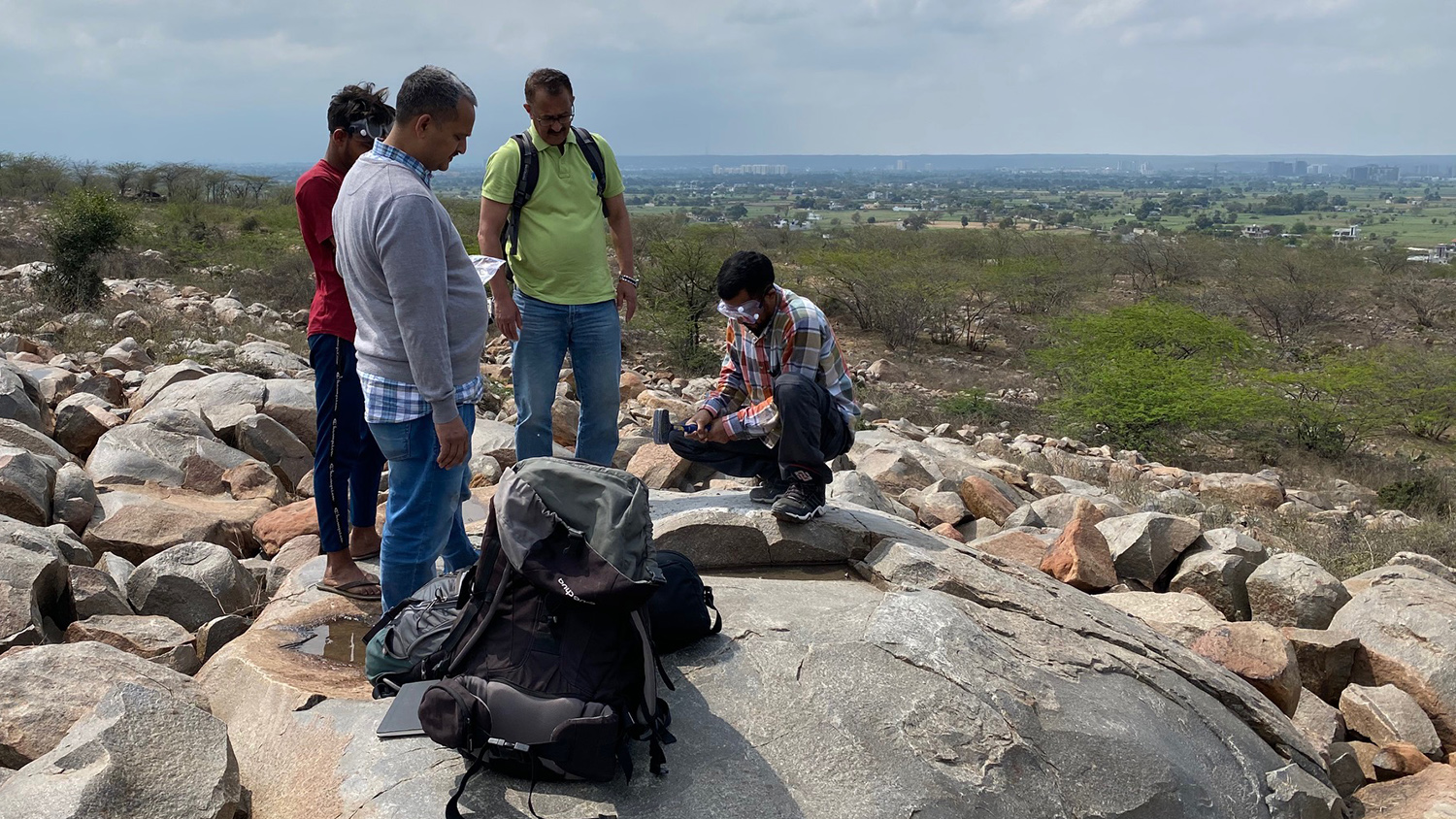
Dr. Carli Arendt’s Geochemistry Lab uses traditional and novel hydrochemistry applications to better understand Earth surface processes in polar, fluvial, coastal, and groundwater settings, with a focus on local ecosystems and communities
Dr. DelWayne Bohnenstiehl’s lab applies sophisticated analytical techniques to understand the physical, biological and acoustic structure of underwater environments
Dr. Kate Davis’s Past & Present Climate Lab explore climate change impacts on oceans through paleoceanography and modern ecology, with special focus on planktic foraminifera and ocean deoxygenation
Dr. Dave Eggleston’s Marine Ecology and Conservation Lab works on testing and refining general ecological theory and concepts in marine systems to make important contributions to our understanding of ecological patterns and processes in marine ecosystems, apply their work to sustainable management of natural resources and coastal communities
Dr. Maggie Ellis Curry’s TERRA Group combines numerical modeling, thermochronology, geochronology, field work, subsurface data, and various structural, basin, and geomorphic analyses to understand source to sink tectonic systems
Dr. David Genereux’s lab focuses on hydrogeology and the coupled fluxes of water and chemicals at the interface between groundwater and surface water, including agricultural nutrients, VOCs, and more recently GenX and related PFAS. Gas exchange at stream surfaces is also a focus area
Dr. Douglas Hamilton’s Atmospheric Computational Lab takes a holistic view of how wildfires and other natural aerosol are a fundamental component of the Earth System
Dr. Roy He’s Ocean Observing and Modeling Group advances oceanographic science through integrated ocean observations, remote sensing data analysis, data-assimilative numerical modeling, and artificial intelligence and machine learning for ocean-atmosphere interactions and coupled marine processes
Dr. Ethan Hyland’s Paleo³ Research Group does field and lab-based research on sediments and fossils from around the world in order to understand past climates and environments, working on a wide range of time periods
Dr. Gary Lackmann and Dr. Walt Robinson’s Extreme Weather and Climate Research Laboratory studies the dynamics and prediction of high-impact weather systems, including tropical and extratropical cyclones, convective storms, and topographically forced flows such as cold-air damming
Dr. Sarah Larson’s Climate Modeling & Predictability Group utilizes coupled atmosphere-ocean climate models and observationally-based datasets to unlock understanding about the processes governing the variability and predictability of climate
Dr. Jay Levine’s Aquatic Epidemiology and Conservation Laboratory works to further understanding of freshwater invertebrates, develop new diagnostic techniques for studying their health and refining techniques that support their conservation and their captive propagation for the augmentation of remaining populations. The group additionally focuses on identifying the vertebrate sources of fecal waste in surface waters.
Dr. Paul Liu’s lab works in areas related to generative AI for geoscience, machine learning, deep learning, coastal marine science and geospatial AI
Dr. Nicholas Meskhidze’s Aerosol-Climate Interactions Lab focuses on advancing the understanding of atmospheric processes and their interactions with climate and marine ecosystems
Dr. Allison Michaelis’s lab investigates high-impact weather in the context of climate change and short-term predictability, utilizing high-resolution models to simulate phenomena such as tropical cyclones, extratropical transition events, snow storms, and atmospheric rivers to examine how these systems and their impacts may change 50–100 years from now
Dr. Helena Mitasova GeoForAll Lab conducts research at the Center for Geospatial Analytics, using tangible geospatial modeling environments, dynamic simulations of landscape processes, and analysis of lidar and UAS data time series to investigate coastal evolution, soil erosion control, natural hazards and sustainable land management. The lab also studies geospatial aspects of human health and environment focusing on water quality, PFAS and COVID-19.
Dr. Chris Osburn’s Marine Biogeochemistry Lab studies dissolved organic matter worldwide, working in rivers and estuaries in North Carolina and particularly on effects of extreme weather events on coastal carbon cycling
Dr. Lewis Owen’s Quaternary Geochronology Laboratories focus on aspects of Quaternary paleoenvironmental change and landscape evolution, hazard mitigation and geoarcheology
Dr. Ryan Paerl’s Aquatic & Marine MicrobiologyLabfocuses upon improving our current understanding of aquatic/marine microbial ecology, physiology, and biogeography
Dr. Matthew Parker’s Convective Storms Group focuses on the dynamics of convective storms, including tornadic supercells and mesoscale convective systems
Dr. Zhen Qu’s Atmospheric Chemistry Modeling Lab applies data driven methods to understand air pollutants, greenhouse gases, and their interactions with the climate and society
Dr. Camilo Rey-Sanchez’s Integrative Biometeorology Lab studies land-atmosphere interactions seeking to push discoveries in understudied biological processes and in parallel, improve Atmospheric and Earth System Models
Dr. Astrid Schnetzer’s Plankton Ecology Lab focuses on the ecology of microbial plankton and zooplankton, addressing how varying natural and anthropogenic processes shape plankton assemblages and how changes in protistan and zooplankton community structure impact biogeochemical cycles in coastal and open ocean environments.
Dr. Eric Wade’s People, Place, and Oceans Lab connects people and oceans through actionable research, using an interdisciplinary approach to explore the drivers and feedbacks of how stakeholders navigate small-scale fisheries contexts
Dr. Karl Wegmann’s Earth Surface Processes Group conducts research in geomorphology, active tectonics and paleoseismology, geoarchaeology, anthropogenic landscape change, and geospatial analytics, conducting research locally and at locations around the world through both field and remote-sensing activities
Dr. Lian Xie’s lab conducts research solving weather, climate, and oceanographic problems from local to regional and global scales using computer models and statistical data analysis tools
Dr. Sandra Yuter’s Environment Analytics Research Group has deep expertise in the analysis of large data sets at the intersection of environmental conditions, ecology, and infrastructure
Dr. Stacy Zhang’s Coastal Community Ecology Lab uses a combination of experimental field studies and analytical syntheses to answer fundamental questions about coastal biodiversity and ecosystem structure
Dr. Lily Hughes’s Ichthyology Lab studies the evolution and biodiversity of fishes through time using a combination of genomics and data from natural history collections